

What is SEO?
Search Engine Optimization (SEO) is the practice of optimizing a website to improve its visibility and ranking in search engine results for relevant keywords and phrases. The goal of SEO is to attract organic (non-paid) traffic to a website by ensuring it is easily discoverable by search engines and provides valuable content to users.
Another important acronym is SERP which stands for Search Engine Results Page. The screenshot below shows the SERP for the Google search query website builder.
Important features of SERP to take note of are:
- Paid ads are often included in the search results, and are marked with the word “sponsored”. Paid results are often displayed at the top or the bottom of the SERP.
- Organic results refers to all the links on the SERP that are not the result of paid advertising. Depending on the SERP, these may include links, images, videos, products, and more.
- Google also adds other features to SERPs to enhance results or help users find related content. This example includes a “People also ask” section of related questions.

The features Google displays on the SERPs changes frequently, even for the same search query.
To see these frequent changes in action, click here to check the current Google search results for the same website builder keyphrase pictured above. We bet that those results will be different. Due to evolving SERP features as well as the indexed content’s continuous change as new URLs are released, the SERPs are highly unpredictable.
How SEO Works
SEO works by optimizing various aspects of a website to improve its relevance, authority, and user experience, thereby increasing its visibility in search engine results. This involves optimizing on-page elements, creating high-quality content, building authoritative inbound links, and addressing technical factors that affect a website’s performance in search results.
Search engine optimization focuses on increasing website URL visibility in search results. Google understands user intent, including informational, navigational, and commercial purposes. Then the algorithm retrieves the best URLs from its index.
Google doesn’t reveal ranking factors for SERPs, but SEO professionals and Google representatives share advice on top factors determining SERP placement.
Here are some of the top factors contributing to your google ranking as identified in a comprehensive study published by Monster Insights:
- High quality content. Humans and search engines are looking for high-quality content. Search engines are increasingly assessing a piece of content’s potential ranking by looking for evidence of Experience, Expertise, Authority, and Trustworthiness, or E-E-A-T.
- A good user experience, particularly on mobile devices. This means websites need to load quickly, be engaging, and have a consistent appearance on mobile devices.
- Pages should be well structured. Commonly known as “on-page optimization,” web pages’ content must be properly structured and labelled so that both people and bots/crawlers can understand it.
- Links to other relevant, quality content. Links, both internal and external, are essential. Links are the paths that users and search engine crawlers use to find relevant pages on websites, both inside and between other websites.
- Location. Your location can be taken into account by search engines, which may then geo-target the results. You’re probably already aware with this since, when you conduct certain searches, Google returns local companies or organizations based on your area.
Another place to stay up updated on changes to Google Search’s functionality is the Google Search Central blog.
Frequently Asked Questions About SEO for NGOs:
Why is SEO important for NGOs?
SEO is important for NGOs because it helps increase visibility, attract supporters, and drive traffic to their websites. By optimizing for relevant keywords, NGOs can reach a wider audience and raise awareness for their cause.
How can SEO help an NGO attract more donors and volunteers?
SEO can help NGOs attract more donors and volunteers by making their website more visible to individuals interested in supporting charitable causes. By creating high-quality content and optimizing for relevant keywords, NGOs can attract individuals who are actively searching for ways to contribute.
What role does content play in SEO for NGOs?
Content plays a crucial role in SEO for NGOs. Creating high-quality, informative, and engaging content not only helps improve search engine rankings but also provides value to supporters and visitors to the NGO’s website.
How long does it take to see results from SEO efforts for an NGO?
The timeline for seeing results from SEO efforts can vary based on the competitiveness of the keywords, the quality of the content, and the effectiveness of the SEO strategy. While some improvements may be noticeable in a few months, significant results often take longer to achieve.
What are some common SEO mistakes NGOs should avoid?
Common SEO mistakes for NGOs to avoid include keyword stuffing, neglecting technical SEO issues, using low-quality or duplicate content, and ignoring the importance of mobile optimization.
Here are 10 steps to help you create an SEO strategy for your NGO:
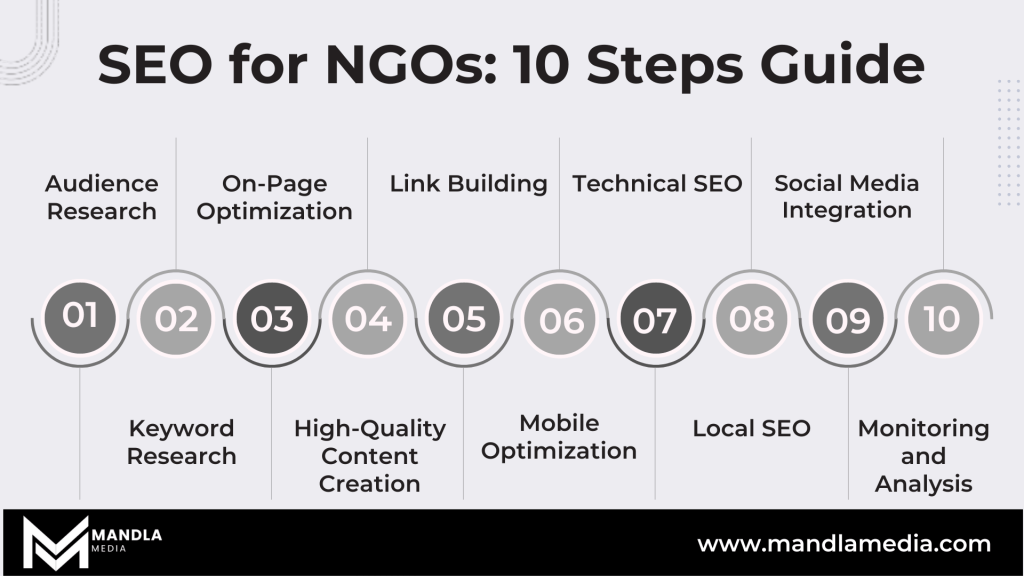
Step 1: Audience Research
Audience research is the first step in building an SEO strategy for NGOs to better understand their target audience and tailor their communication strategies accordingly. This research can help NGOs to identify the needs, preferences, and behaviors of their target audience, which can help them to develop more effective communication strategies.
NGOs can conduct audience research in several ways, including surveys, focus groups, and interviews. Surveys are a popular method of audience research, as they allow NGOs to collect data from a large number of people quickly and efficiently. Focus groups and interviews, on the other hand, can provide more in-depth insights into the attitudes and beliefs of the target audience.
One of the most important things that NGOs need to consider when conducting audience research is the diversity of their target audience. NGOs often work with diverse populations, including different age groups, ethnicities, and socioeconomic backgrounds. It is essential to ensure that the research is conducted in a way that is sensitive to these differences and that the findings are representative of the entire target audience.
By conducting audience research, NGOs can better understand the needs and preferences of their target audience and develop communication strategies that are more effective in reaching and engaging them. This can help NGOs to achieve their goals and make a positive impact on the communities they serve.
Step 2: Keyword Research
Keyword research is a vital component of any successful SEO strategy. It involves identifying the specific words and phrases that people use to search for information, products, or services related to your website. By understanding what keywords are most relevant for your content, you can optimize your website to rank higher in search engine results pages (SERPs), attract more traffic, and ultimately increase your revenue.
There are several tools available to help with keyword research, including Google Keyword Planner, Ahrefs, Semrush, and Moz. These tools allow you to identify the most popular search terms related to your industry, as well as the level of competition for each keyword.
However, it’s important to note that keyword research should not solely be focused on finding the highest volume keywords. Instead, it’s important to find the “low-hanging fruit” keywords that your competitors may have overlooked. These keywords may have lower search volume, but they can still drive targeted traffic to your website.
Once you have identified your target keywords, it’s important to incorporate them into your website content in a natural and strategic way. This includes optimizing your page titles, meta descriptions, headers, and content body. By doing so, you can improve your website’s relevance and authority in the eyes of search engines, which can lead to higher rankings and more traffic.
Step 3: On-Page Optimization
On-page optimization is a critical aspect of search engine optimization (SEO) that involves optimizing individual web pages to improve their visibility and ranking on search engine results pages (SERPs). In the case of NGOs, on-page optimization can help them attract more visitors to their websites, increase their online visibility, and ultimately achieve their organizational goals.
One effective on-page optimization technique for NGOs is to ensure their website is mobile-friendly. With more and more people accessing the internet via mobile devices, having a website that is optimized for mobile is crucial. This can be achieved by using responsive web design, which ensures that the website’s layout and content adjust to fit the screens of different devices.
Another important aspect of on-page optimization for NGOs is to use relevant keywords in their website’s content. This helps search engines understand what the website is about and can improve its ranking for relevant search queries. NGOs should identify the keywords that their target audience is likely to use when searching for information related to their cause and incorporate them into their website’s content in a natural and meaningful way.
NGOs should ensure that their website’s content is well-structured and easy to navigate. This can include using descriptive headings, clear and concise language, and organizing content into logical sections. A well-structured website not only helps visitors find what they’re looking for quickly and easily, but it also helps search engines understand the website’s content and improve its ranking.
Step 4: High-Quality Content Creation
Creating high-quality content for NGOs can be a challenging task, but it is one that is essential for their success. NGOs typically rely on their online presence to connect with their audience and raise awareness about their cause. As such, their content needs to be informative, engaging, and persuasive.
One of the most important aspects of high-quality content creation for NGOs is to ensure that the content is tailored to their specific audience. Understanding the demographics, interests, and needs of the target audience is essential to creating content that resonates with them. This can be achieved through thorough research, surveys, and feedback from the audience.
Another crucial element of high-quality content creation for NGOs is to ensure that the content is visually appealing and easy to read. This can be achieved through the use of compelling images, graphics, and videos that support the message being conveyed. The content should also be well-organized, with a clear structure and hierarchy that guides the reader through the information.
High-quality content for NGOs should be authentic and reflective of the organization’s values and mission. It should be written in a tone that is appropriate for the audience and the message being conveyed. The content should also be accurate and up-to-date, with sources cited where necessary.
Step 5: Link Building
Link building is an important aspect of search engine optimization (SEO), and it is particularly important for non-governmental organizations (NGOs) that rely on donations and volunteers. Link building is the process of acquiring hyperlinks from other websites to your own, and it is a crucial factor that search engines use to determine the relevance and authority of your website.
For NGOs, link building is an effective way to raise awareness about their cause and increase their online visibility. The first step in link building is to identify relevant websites that can link back to your organization’s website. This can include websites of other NGOs that share similar goals or causes, as well as government agencies, academic institutions, and media outlets that cover topics related to your organization’s work.
Once you have identified potential websites to target, you can start reaching out to them and requesting a link to your website. This can be done through email outreach, social media engagement, or by offering to contribute guest posts or articles to their website.
It is important to note that link building is not just about acquiring as many links as possible. Quality and relevance are key factors that search engines consider when evaluating links. Therefore, it is important to focus on building links from reputable, authoritative websites that are relevant to your organization’s goals and mission.
Note: never pay for backlinks. Google states clearly that purchasing backlinks to improve your search rankings is a form of link spam, and sites are routinely penalized for engaging in link spam.
Step 6: Mobile Optimization
Mobile optimization is an essential aspect for NGOs that want to reach a broader audience. Given the increasing number of people who access the internet through their mobile devices, NGOs must embrace mobile optimization to ensure that their websites and online content are accessible on mobile devices. Failure to optimize their websites for mobile devices may result in a decline in traffic, which can have a significant impact on their ability to reach their target audience.
To optimize their websites for mobile devices, NGOs should first ensure that they have a mobile-friendly layout that is easily navigable on smaller screens. They should also ensure that their website loads quickly on mobile devices. Slow loading websites can be frustrating for visitors and may deter them from accessing the site in the future. Additionally, NGOs should ensure that their website content is optimized for mobile devices. This means that the text should be easy to read on smaller screens, and images and videos should be optimized for quick loading on mobile devices.
Step 7: Technical SEO
When it comes to technical SEO for NGOs, there are a few important factors to keep in mind. First and foremost, it’s crucial to have a website that is user-friendly and easy to navigate. This means ensuring that your website is mobile-friendly, as more and more people are accessing the internet through their phones.
In addition to a user-friendly website, NGOs should also focus on optimizing their website for search engines. This includes using relevant keywords throughout your website content, as well as optimizing your website’s metadata, including the title tag and meta description. It’s also important to ensure that your website’s URL structure is optimized for search engines, as this can have a big impact on how well your website ranks in search results.
Another important factor to consider when it comes to technical SEO for NGOs is website speed. A slow website can have a negative impact on your website’s search engine rankings, so it’s important to ensure that your website is optimized for speed. This includes minimizing the use of large images or videos, as well as optimizing your website’s code to ensure that it loads quickly.
NGOs should also focus on building high-quality backlinks to their website. This can be done by reaching out to other websites in your niche and asking them to link to your website. It’s also important to ensure that your website’s content is high-quality and relevant, as this can help attract natural backlinks over time. By focusing on these key technical SEO factors, NGOs can improve their website’s search engine rankings and attract more traffic to their website.
Step 8: Local SEO
Local SEO can be a powerful tool for non-governmental organizations (NGOs) to increase their visibility within their local communities and attract more supporters. By optimizing their online presence for local search, NGOs can increase their chances of appearing in relevant search results when people in their area search for keywords related to their cause.
To get started with local SEO, NGOs should focus on creating a Google My Business (GMB) profile that accurately reflects their organization’s information, including name, address, phone number, and website. By doing so, they can help potential supporters find them more easily and provide important information about their organization.
NGOs should also focus on creating high-quality, informative content that is relevant to their local community. This can include blog posts, videos, and social media posts that highlight their organization’s work and impact within the community. By creating content that resonates with the local audience, NGOs can increase their relevance and authority in the eyes of search engines.
Finally, NGOs should focus on building relationships with other local organizations and community influencers. By partnering with other organizations and individuals who are passionate about their cause, NGOs can increase their visibility and credibility within their community. This can lead to more online mentions, backlinks, and social media shares, all of which can help improve their local SEO efforts.
Step 9: Social Media Integration
Social media integration has become an essential component of any non-governmental organization’s (NGO) digital strategy. With the emergence of social media platforms such as Facebook, X(Twitter), Instagram, LinkedIn and others, NGOs can now reach a wider audience and engage with their supporters in a more personalized and interactive manner.
The integration of social media in an NGO’s strategy requires a thorough understanding of its target audience, their interests, and the social media platforms they use the most. NGOs should create a social media plan that includes a content strategy, a posting schedule, and a plan for responding to comments and messages.
NGOs should also leverage the power of social media influencers to help spread their message. Partnering with individuals or organizations with large followings on social media can help NGOs reach a wider audience and increase their engagement levels. Additionally, NGOs should also consider investing in social media advertising to reach a broader audience that may not be following them on social media.
Step 10: Monitoring and Analysis
To effectively monitor and analyze the effectiveness of an NGO’s SEO strategy, it is important to track key metrics such as website traffic, bounce rate, and conversion rate. Website traffic refers to the number of visitors to a website, while bounce rate is the percentage of visitors who leave a website after viewing only one page. Conversion rate measures the percentage of visitors who take a desired action, such as making a donation or signing up for a newsletter.
NGOs can use a variety of tools to monitor and analyze their SEO performance, such as Google Analytics, SEMrush, and Moz. These tools can provide valuable insights into which keywords and phrases are driving traffic to a website, how visitors are interacting with the site, and where improvements can be made to increase engagement and conversion rates.
By following these steps, your NGO can develop a strong SEO strategy that improves your online visibility, attracts more supporters, and ultimately helps you further your cause.
When it comes to implementing SEO for NGOs, it’s important to consider the resources, personnel, and budget required for a successful SEO strategy. Here are some key factors to take into account when planning for SEO resources and costs for NGOs in South Africa, where the currency is the South African Rand (ZAR):
SEO for NGO’s: Resources, people, and budget
Resources
- Content Creation: NGOs will need to allocate resources for creating high-quality, relevant content such as blog posts, articles, videos, and infographics. This may involve hiring content creators, writers, and graphic designers or outsourcing content creation to agencies.
- Technical Expertise: SEO often requires technical expertise to address issues related to website structure, speed, mobile optimization, and other technical aspects. NGOs may need to invest in web developers or technical consultants to support their SEO efforts.
- Tools and Software: Investing in SEO tools and software for keyword research, analytics, and website optimization can be beneficial. Popular tools include Ahrefs, SEMrush, Moz, and Google Analytics.
Personnel
- SEO Specialist: NGOs may consider hiring an in-house SEO specialist or working with an SEO agency to manage and execute the SEO strategy. The specialist would be responsible for keyword research, on-page optimization, link building, and monitoring the performance of the NGO’s website.
- Content Creators: Depending on the scale of content production, NGOs may need to hire or outsource content creators to consistently produce high-quality, SEO-friendly content.
- Web Developers: For technical SEO and website optimization, NGOs may need the support of web developers to implement changes and improvements on their website.
Budget
- The budget for SEO can vary widely based on the scope of the NGO’s SEO strategy, the competitiveness of the target keywords, and the level of ongoing content production and optimization.
- Costs may include personnel salaries, agency fees, content creation expenses, software subscriptions, and any additional costs associated with technical improvements to the website.
It’s important for NGOs to carefully assess their specific needs and goals when determining the resources and budget required for SEO. While there are no fixed costs for SEO as they can vary greatly, it’s essential to allocate sufficient resources to ensure the effectiveness of the SEO strategy and drive meaningful results for the NGO’s online presence.
Need professional support building your SEO strategy? Let us help you create and implement your next SEO or content marketing initiative.
 MANDLA MEDIA
Leave a comment